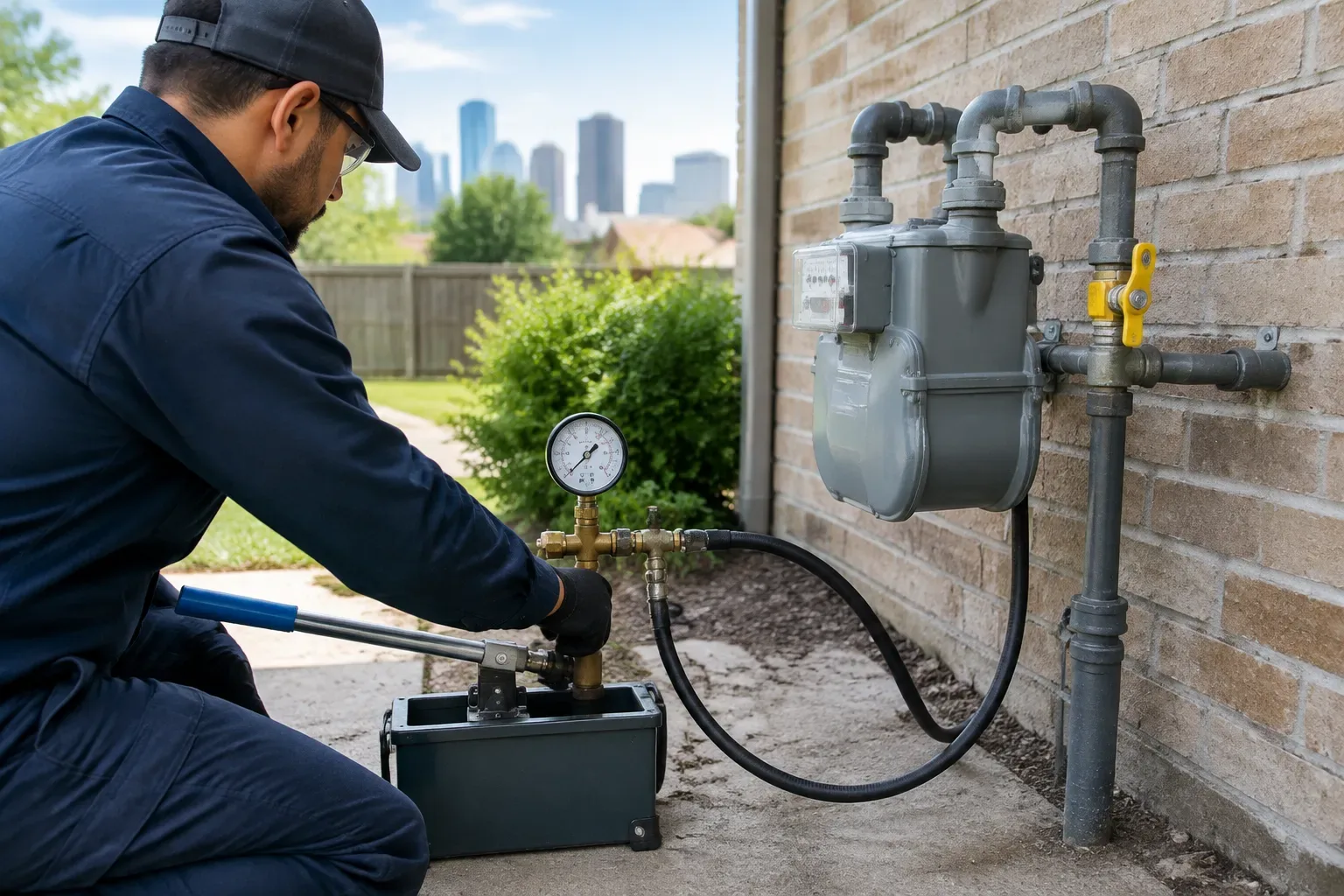
Is a Gas Line Pressure Test Needed Near Bissonnet in Sharpstown?
Possibly. A gas line pressure test is commonly considered after gas piping is installed, extended, repaired, moved, or disconnected and reconnected. It may also be part of resolving a failed inspection, unexplained pressure loss, or a utility-related service interruption. The right answer depends on the exact section of piping, the work performed, and current requirements from the authority having jurisdiction.
If you smell gas, hear hissing, or believe there may be an active leak, do not wait for a routine pressure test. Leave the area, avoid ignition sources, and contact the gas utility or emergency responders from a safe location. For non-emergency questions near Bissonnet in Sharpstown, Houston Plumbers Pro LLC can be a starting point for plumbing service information and next steps.
Quick Answer
A pressure test may be needed when work affects the gas piping itself, not simply because an appliance is old or acting up. It verifies whether an isolated, defined portion of piping can hold test pressure under a documented procedure. It does not automatically locate the exact point of a leak, confirm that an appliance is operating correctly, or replace a utility-side safety investigation.
Before scheduling any work, confirm these points:
- What gas piping was installed, altered, repaired, or disconnected?
- Is the concern inside the building, on customer-owned piping, at an appliance, or on the utility side?
- Has an inspector, utility representative, or contractor requested a specific test?
- Are permits or inspections required for this scope under current City of Houston rules?
When is a gas pressure test usually appropriate?
The strongest reason for a test is a change to the piping system. New branches for an added appliance, a relocated line, repairs to a damaged section, and reconnection after work can each require code and inspection review. Current Houston requirements can vary by scope, so a licensed professional should confirm the applicable permit and inspection path before treating any project as routine.
A request for testing can also follow a failed inspection, a utility shutoff, a meter-related event, or a suspected piping problem. That does not mean every concern requires a whole-building test. The tested section should be defined clearly so the result answers a useful question.
Older and newer properties near Bissonnet can have different gas-piping layouts and appliance arrangements. The property condition and the extent of the alteration matter more than the neighborhood name. A professional inspection can determine whether testing the entire accessible system, one branch, or a newly repaired segment is appropriate.
Is a pressure test the same as a gas leak test?
No. These terms are often used interchangeably, but they describe different diagnostic tools. A pressure test checks whether a sealed, isolated section maintains pressure over the required period. Leak detection seeks to identify the location of escaping gas. Appliance testing focuses on the appliance and its connected components.
Gas piping pressure test
This evaluates whether a defined, isolated piping section holds the prescribed test pressure for the required duration. It is commonly tied to installation, alteration, repair, or inspection requirements.
Electronic or combustible-gas leak detection
This is used to investigate a suspected active leak and help identify where gas may be escaping. A detector result may lead to more targeted diagnosis or repairs.
Appliance-specific inspection
This examines a gas-fired appliance, its connector, shutoff valve, and related operation. An appliance concern may not require a whole-property piping test.
Utility-side investigation
The gas utility addresses hazards or issues involving its equipment and service responsibilities. A plumbing contractor and the utility may each have separate roles in one event.
The most common mistake is assuming a pressure test alone will find every issue. Concealed piping, valves, regulators, appliance-internal faults, and utility-side problems can require different procedures. Conversely, ordering a broad test for an appliance-only issue can add work without answering the actual question.
What symptoms should prompt emergency action instead of a routine appointment?
Treat a suspected active gas leak as a safety issue first. An observable symptom, such as a gas odor or hissing sound, does not prove where the leak is or who owns the affected equipment. It does mean the situation needs immediate, appropriate response.
According to the Pipeline and Hazardous Materials Safety Administration's natural gas safety guidance, move away from a suspected leak, avoid flames, electrical switches, vehicles, and other ignition sources, then contact the gas utility or emergency responders from a safe location.
Potential causes can include customer-owned gas piping, a connector, a valve, an appliance component, or utility equipment. Only an inspection can produce a professional finding about the source. Do not use a routine plumbing appointment as a substitute for emergency leak response.
What happens during a professional gas line pressure test?
A competent test begins with defining the scope, not attaching a gauge blindly. The professional needs to know which piping is being evaluated, what has changed, what appliances are connected, and whether the work will require coordination with an inspector or utility.
- Describe the reason for the test, such as a new appliance branch, piping repair, failed inspection, or unexplained concern.
- Identify the section of gas piping to be tested and document relevant appliances, valves, and recent work.
- Have a qualified professional isolate or disconnect components as required by the applicable procedure, rather than attempting this yourself.
- Perform the test using suitable calibrated equipment and the test conditions required for that system and jurisdiction.
- Record the result, repair confirmed deficiencies if found, and verify whether inspection, permit, or appliance-reconnection steps remain.
Exact test pressure, duration, test medium, and isolation requirements should not be guessed from a blog post. They depend on the governing code, the system type, and the approved procedure for the project. Ask for the tested section, conditions used, pass or fail result, and any remaining inspection requirements in writing.
Does replacing a gas water heater require testing of the whole gas system?
Not automatically. A water heater replacement may involve an appliance connection only, or it may require changes to the gas branch piping, shutoff arrangement, venting, or other related systems. Those are different scopes of work with different inspection questions.
If the gas piping is extended, relocated, repaired, or otherwise altered, a pressure test and permit review may be relevant. If the concern is limited to the appliance, the useful evaluation may instead focus on the appliance connection and installation requirements. Residential water heater service information can help distinguish a water-heater issue from a broader piping concern.
Do not assume that a new appliance solves an existing piping problem, or that a pressure test proves all appliance functions are safe. Both systems deserve the right inspection for the work performed.
Who is responsible for gas piping near the property?
Responsibility can be divided among the property owner, a licensed plumbing contractor, the local permitting authority, and the gas utility. The dividing line is not always obvious from the meter or the location of a symptom.
Customer-owned interior piping and appliance connections are often evaluated through plumbing work. Utility-owned equipment and supply-side concerns belong with the gas utility. An inspector may require documentation or approval for certain permitted work. A failed test result on customer-owned piping may call for diagnosis and repair, while a utility-side finding follows the utility's process.
For a business, restaurant, or other commercial space, gas piping concerns can involve more appliances, greater operating disruption, and site-specific safety procedures. The commercial gas leak repair page addresses the commercial service category, while a property-specific evaluation determines whether a pressure test is the correct next step.
What should be included in a written estimate?
A useful estimate separates diagnosis from repair and testing. That makes it easier to see what work is actually being proposed and prevents a reader from assuming that one line item covers every later requirement.
Ask whether the estimate identifies:
- The piping section or appliance connection being evaluated
- Whether the work includes leak diagnosis, repair, pressure testing, or all three
- Whether appliance disconnection and reconnection are included
- Whether permit or inspection coordination is included or excluded
- What documentation will be provided after testing
- What may change the scope, such as limited access, concealed piping, or additional repairs
Houston Plumbers Pro LLC states that it provides written estimates before work begins. For a project involving new water or drainage lines alongside other building work, its residential installation information may also help clarify how separate plumbing scopes should be planned rather than bundled by assumption.
How can you prepare safely before a gas line assessment?
Preparation should provide information, not involve hands-on gas work. Make a simple list of gas-fired appliances, note when the concern began, and gather any recent repair invoices, inspection notices, or utility instructions. Clear safe access to the relevant appliance area if possible, but do not move gas connections, remove covers, or test lines yourself.
If the issue followed renovation work, appliance replacement, or a utility visit, mention that timeline. It helps determine whether the likely next step is a routine evaluation, permit review, utility coordination, or emergency response. For broader local plumbing topics, the Houston Plumbers Pro blog provides additional homeowner guidance.
Ready to discuss your project?
For a non-emergency gas-piping question near Bissonnet in Sharpstown, request a written scope that separates diagnosis, testing, and repair.
FAQ
Do I need a gas line pressure test after a gas line repair?
It may be appropriate after a repair, especially if the repair changed, opened, disconnected, or reconnected gas piping. The required procedure depends on the repaired section, the type of system, and current local requirements. Ask the professional to specify whether the repair scope includes a pressure test, leak-location work, permit review, and any inspection coordination. A repair receipt alone does not necessarily document each of those items.
How long does a gas pressure test take?
There is no reliable universal timeframe because setup, isolation, access, required test duration, repairs, and inspection coordination can all affect the visit. Rather than relying on a generic time estimate, ask what portion of the system will be tested, whether appliances must be disconnected, and whether a failed result could add diagnostic work. A clear scope is more useful than a guessed appointment length.
Can I use soap bubbles to check a gas leak myself?
Do not use a DIY test to rule out a suspected gas leak or to reopen equipment. A suspected leak requires evacuation from the area and contact with the gas utility or emergency responders from a safe location. Small leaks, concealed piping issues, and conditions inside appliances may not be safely or reliably evaluated this way. Professional residential gas leak repair is the appropriate service category once immediate safety steps are addressed.
Will a failed pressure test tell me exactly where the leak is?
Not necessarily. A failed result indicates that the tested section did not hold pressure under the selected procedure. It may narrow the investigation, but further leak detection and inspection are often needed to identify the location and cause. The finding could involve accessible piping, concealed piping, a valve, an appliance connection, or another component. The result should guide diagnosis, not be treated as the final repair plan.
Do I need a permit for gas piping work in Houston?
Some gas-piping installation, alteration, relocation, and repair work may require permit or inspection review, but the current requirement depends on the exact scope and the authority having jurisdiction. Confirm the requirement before work begins rather than relying on what was required for a prior project or a neighboring property. A qualified professional can help identify the work description that needs to be verified with the City of Houston.
Is a gas smell always caused by a gas line leak?
No. A gas odor is an observable warning sign, not proof of one particular cause. It could relate to customer-owned piping, an appliance connection, a valve, utility equipment, or another condition that needs investigation. Because the potential consequences are serious, act on the safety guidance first: leave the area, avoid ignition sources, and report the concern from a safe location.
Can a plumber test only one branch of my gas piping?
Often, a defined section can be evaluated when that is the relevant scope, but whether it is appropriate depends on the piping layout, recent work, isolation requirements, and applicable procedure. Testing only the affected branch can be more useful than a broader test when a specific repair or addition is being reviewed. A professional should explain what the result covers and what it does not cover.
What should I do after a gas utility shuts off service?
Follow the utility's instructions first. Do not attempt to restore service, relight appliances, or alter piping yourself. The utility may require its own safety steps, while a plumbing contractor may be needed to evaluate customer-owned piping or make repairs. If work is needed on the building's gas system, ask whether testing, documentation, inspection, and appliance reconnection are separate parts of the process.
