Should I Repair or Replace a Sewer Line Near S Braeswood?
Repair is usually the better choice when an inspection finds one accessible, isolated defect and the rest of the private sewer pipe is sound. Replacement becomes more reasonable when the line has multiple failures, broad deterioration, severe misalignment, or a collapse. A backup, odor, or slow drain alone cannot make that call.
For a property near S Braeswood, the practical first step is to identify the exact issue with a cleanout inspection and, when practical, a sewer camera. Houston Plumbers Pro LLC can be a starting point for Southwest Houston plumbing concerns, but the repair-versus-replacement decision should follow documented findings, not a guess based on symptoms.
Quick Answer
Choose a localized repair when a camera shows a single crack, separated joint, or damaged section with structurally sound pipe on both sides. Consider full replacement when footage shows repeated defects, a line that cannot hold its alignment, extensive root damage, widespread corrosion or deterioration, or a collapsed segment.
Trenchless rehabilitation can sometimes reduce surface disruption, but it is not automatically an option. Pipe size, bends, access, connections, structural condition, and the location of the defect all affect whether it can work. Get the camera footage, the defect location, and a written scope before approving any approach.
What symptoms suggest a sewer-line problem, and what do they not prove?
Watch for several drains slowing at once, wastewater backing up at a low fixture, sewage odor outdoors or indoors, wet areas with no clear source, or repeated cleanout overflows. These are observable symptoms. They do not prove that a sewer lateral is broken.
Possible causes include a localized blockage, roots entering through a joint, grease buildup, an offset connection, a low area that holds water, a damaged section of pipe, or a problem farther downstream. A plumbing issue outside the private sewer lateral, including a public-system or drainage issue, may also be involved. Only an inspection can distinguish among those possibilities.
Heavy rain can coincide with a backup by increasing groundwater and sewer-flow pressures, but rain does not by itself prove that a private line needs replacement. Likewise, shifting soil can stress buried joints, which is a reason to locate a defect carefully before deciding how much pipe to disturb.
How does a sewer camera inspection guide the decision?
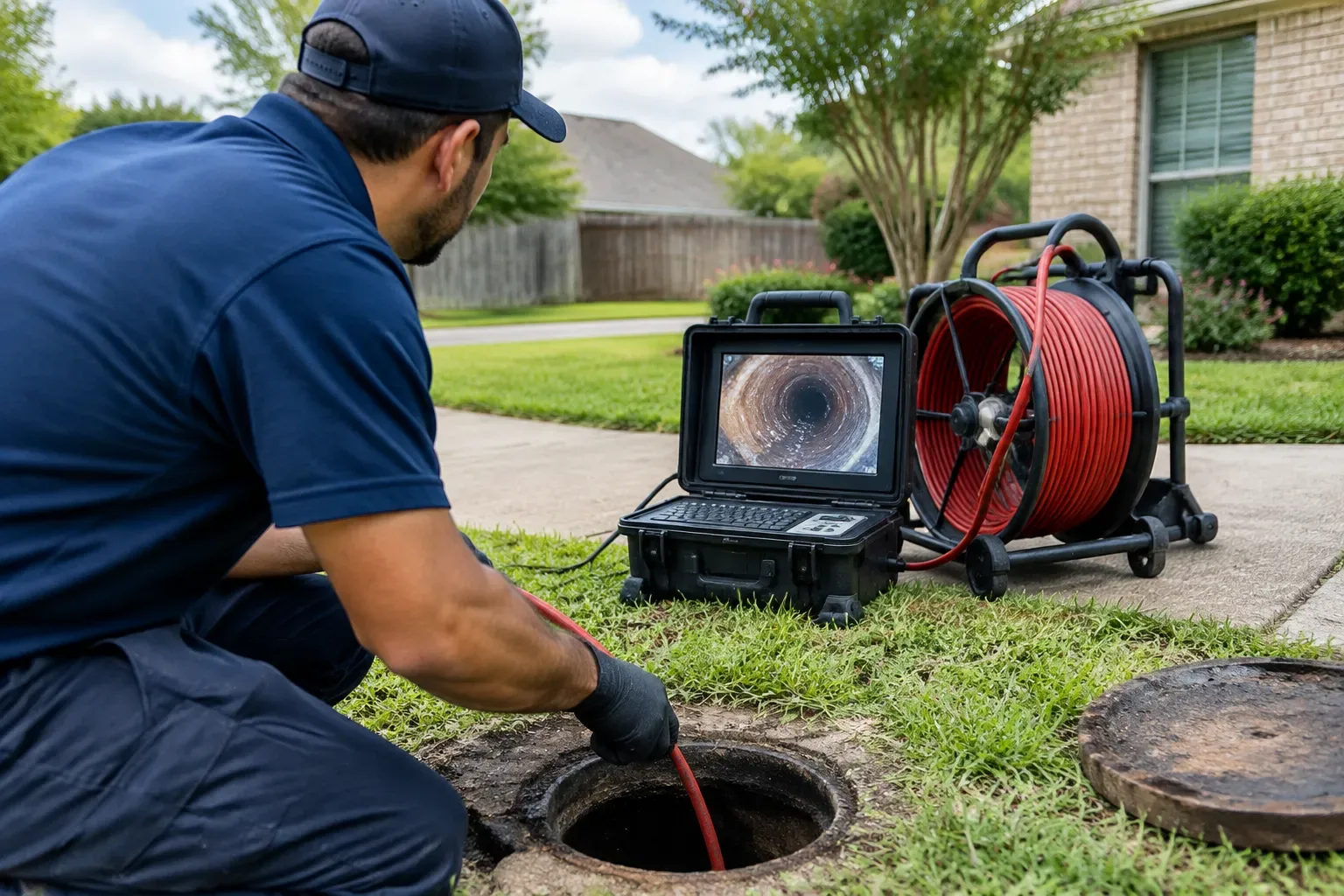
A sewer camera inspection places a small camera through an accessible cleanout or other entry point so the inspector can see the inside of the pipe. It can document the condition that matters most: pipe material when visible, root intrusion, cracks, separated or offset joints, standing water, corrosion, obstructions, and collapse.
Ask the inspector to mark or explain the defect location in relation to the house, property line, driveway, landscaping, and other fixed features. A camera may show standing water that suggests a low spot, often called a belly, but it does not always establish the pipe's exact slope or depth. Locating and, when needed, further investigation help define the actual repair scope.
A useful report should answer these questions:
- Is the problem one isolated section or a pattern along the line?
- Is the pipe still structurally sound around the visible defect?
- Is there a blockage that can be removed, or physical damage that remains after clearing?
- Where is the issue relative to hardscape, mature landscaping, and the property boundary?
- Does the affected segment appear to be private plumbing, or does ownership need to be confirmed with the relevant authority?
Municipal wastewater infrastructure and private property plumbing are not automatically the same asset. The EPA's overview of municipal wastewater systems describes the broader public collection and treatment context, but the responsibility boundary for a particular property must be verified locally before work reaches an easement, sidewalk, street, or public connection.
When is a spot sewer repair enough?
A spot repair is most defensible when the damage is limited, reachable, and surrounded by pipe that appears sound. For example, one failed joint or a short cracked section may be excavated and replaced without removing a long run that is still in good condition.
The mistake is assuming that a successful spot repair always means the system is solved. If video shows several defects elsewhere, repairing the first visible break can leave the next failure waiting in the same line. Request a scope that states what was inspected, what was not visible, and why the proposed repair length is appropriate.
For homeowners comparing pipe and drainage work, residential water-line and drainage installation information can help frame the broader installation side of the project.
When does replacement make more sense than another repair?
Replacement deserves serious consideration when the pipe has repeated structural problems rather than one repairable defect. Common professional findings that may support replacement include a collapse, severe or repeated offsets, multiple separated joints, extensive deterioration, recurring root intrusion through numerous failures, or damage across sections that would require several separate excavations.
Replacement is not automatically the largest or best answer. A complete run may be unnecessary if inspection shows only one isolated failure. On the other hand, choosing the smallest repair solely because it has less immediate disruption can become expensive if it leaves known defects in place.
Established yards can complicate access. Mature trees, patios, fences, irrigation, driveways, slabs, and landscaping may affect the excavation route and restoration needs. The property itself must be evaluated rather than assuming every nearby home has the same pipe material, depth, or layout.
Which repair methods should you compare?
The right approach follows the defect pattern and access conditions, not a preference for one method. Compare the method against the full condition of the pipe and the restoration required afterward.
| Option | Best fit | Surface disruption | Important limitation |
|---|---|---|---|
| Targeted clearing | A removable blockage or limited roots with no confirmed structural failure | Usually low | Restores flow but may not correct cracked, offset, or deteriorated pipe |
| Spot excavation and repair | One accessible damaged section with sound pipe around it | Limited to the excavation area | Does not address separate defects elsewhere in the line |
| Pipe lining | A suitable existing pipe with compatible access, alignment, and structural condition | Often less than open-cut work | Not feasible for every diameter, bend, connection, collapse, or obstruction |
| Pipe bursting | A qualifying line where replacement by pulling new pipe is feasible | Requires access pits | Alignment, access, nearby utilities, and site conditions can rule it out |
| Open-cut replacement | Widespread damage, collapse, or a route unsuitable for trenchless work | Can be substantial | Restoration of hardscape and landscaping may add scope |
For a commercial property with a sewer or drainage installation decision, see the overview of commercial water-line and drainage installation. Commercial sites may have different access constraints, operating needs, and coordination requirements than a single-family property.
What should you do before approving sewer work?
A written estimate should separate diagnosis, pipe work, excavation, disposal, restoration, permits or inspections if applicable, and any after-hours charges. It should also identify whether the proposal applies only to the private lateral or includes work near a boundary, easement, sidewalk, or public connection.
Before digging, utilities need to be addressed. The national 811 excavation-safety guidance explains why contacting the appropriate utility-locating service before excavation is a basic planning step. Confirm who will request locates, what markings cover, and how any unmarked private lines will be handled.
- Reduce water use if sewage is backing up or surfacing, and avoid repeated chemical drain treatments.
- Have the accessible cleanout inspected and request camera footage or clear still images when practical.
- Ask for the defect to be located and explained in relation to the home, yard, driveway, and property boundary.
- Compare a localized repair, trenchless option if suitable, and replacement only against the documented condition of the line.
- Review the written estimate for restoration, utility locating, permits or inspections if applicable, ownership boundaries, and warranty terms.
How urgent is a damaged sewer line?
An active sewage backup, wastewater surfacing, or overflow from a cleanout needs prompt professional guidance because it can damage finishes and create a sanitation concern. Reduce water use until the situation is assessed. A slow drain without an active overflow may allow time for planned diagnosis, but it should not be ignored if several fixtures are involved or the condition keeps returning.
Do not use a gas odor as evidence of a sewer issue. If the odor could be gas, follow gas-safety guidance and seek appropriate help. Businesses that need information on that separate hazard can review commercial gas leak repair.
What questions should you ask about cost and restoration?
There is no reliable one-size-fits-all sewer-line price without the pipe length, depth, material, defect location, access route, and restoration details. A quote can change substantially when work crosses a driveway, patio, landscaping, fence line, slab area, easement, or public right-of-way.
Ask each contractor to clarify:
- What camera evidence supports repair or replacement?
- What length of pipe is included, and from which points?
- Will the scope disturb a driveway, landscaping, irrigation, fence, slab, or interior finish?
- Who handles utility locating, permits, inspections, and authority coordination if needed?
- Is disposal included?
- What restoration is included, and what is excluded?
- What labor and material warranty terms apply to the exact scope?
The practical takeaway is simple: approve the least invasive option that fully addresses the documented condition of the pipe, not merely the symptom that brought the problem to attention.
Ready to discuss your project?
Request a documented sewer-line assessment near S Braeswood before choosing between a targeted repair and replacement.
FAQ
Can a sewer camera tell me if I need a new sewer line?
A camera can show conditions that strongly influence the choice, including root intrusion, cracks, offsets, standing water, corrosion, and collapse. It cannot always verify every detail, such as exact depth, all exterior pipe conditions, or responsibility at a boundary. Ask to see the footage and have the inspector explain whether the damage is isolated or repeated. For additional plumbing education, browse the Houston Plumbers Pro blog.
Are recurring sewer backups always a reason to replace the pipe?
No. Recurring backups can come from a persistent blockage, roots at one joint, buildup, a damaged pipe section, or a downstream issue. Replacement may be justified when inspection finds multiple structural defects or broad deterioration, but it is not the default response. The key question is whether clearing restores a structurally sound line or only temporarily opens a line with ongoing physical damage.
Can tree roots be removed without replacing the sewer line?
Sometimes. Roots can be cleared when they are obstructing flow, but clearing does not close the opening that allowed roots into the pipe. If roots entered through one otherwise repairable joint, a targeted repair may be enough. If footage shows roots entering at many joints or widespread pipe damage, clearing alone may lead to repeated blockages and a larger repair plan may be more sensible.
Does a sewer line have to be dug up through my driveway?
Not necessarily. The excavation path depends on where the defect is, how deep the line runs, available access, pipe condition, and whether a suitable trenchless method is feasible. A marked defect location is more useful than assumptions based on where a backup appears inside the home. Ask the estimator to show the proposed access points and identify what driveway or hardscape restoration is included.
Who owns the sewer line between my house and the street?
Ownership can change at the property line, a connection point, easement, or another locally defined boundary. Do not assume the entire run is private or public based on where it lies. Verify responsibility with the relevant local utility or authority before authorizing work near a sidewalk, street, or public connection. The repair estimate should state which segment it covers.
Is a sewer backup during heavy rain proof that my lateral is failing?
No. Rain can add stress to drainage and sewer systems and may reveal an existing weakness, but it does not prove the private lateral is the cause. The same event could involve a restriction, a downstream issue, groundwater effects, or a public-system condition. If the issue repeats, document when it occurs and obtain a camera inspection or other appropriate evaluation.
What should be included in a sewer repair estimate?
Look for the diagnosis, exact repair method, pipe length, excavation or access-pit scope, disposal, restoration, utility locating, permit or inspection responsibilities if applicable, and warranty terms. It should also explain exclusions, especially landscaping, irrigation, concrete, interior finishes, or work beyond the private line. A clear written estimate makes it easier to compare a spot repair with a more extensive replacement proposal.
Could a sewer smell actually be a gas leak?
It is possible for odors to be misidentified, and a sewer smell should not be casually assumed to be natural gas or vice versa. If there is any concern that the odor could be gas, treat that as a separate safety issue and seek appropriate assistance rather than testing it yourself. Residential readers can review information about gas leak repair for that distinct problem.
